Deliver
Available today, for Claude Code.Everyone runs the same, current capabilities.
Skills, agents, hooks, instruction files and packs from your Git registries, installed on every machine. Each registry serves one coding tool. Codex, Cursor and GitHub Copilot registries are catalogued and marked "not installable yet"; installing for them, and for Kiro, is next.
No upload API and no content store: artifact content stays in your Git. Only the web app reads Git, so no developer needs Git access. Publishing is a commit or a pull request.
The desktop app does the delivery. It installs and updates artifacts on each machine, with or without an editor open.
New versions are offered, never forced. Artifacts touch only their own marked block in a developer's files. Local edits show up as drift for the developer to resolve.
Measure
Available today.You can see what runs and what it costs.
Forge scans each machine for skills and agents that no registry delivered and shows them by team, with an estimated context cost per machine. This is your shadow-AI view.
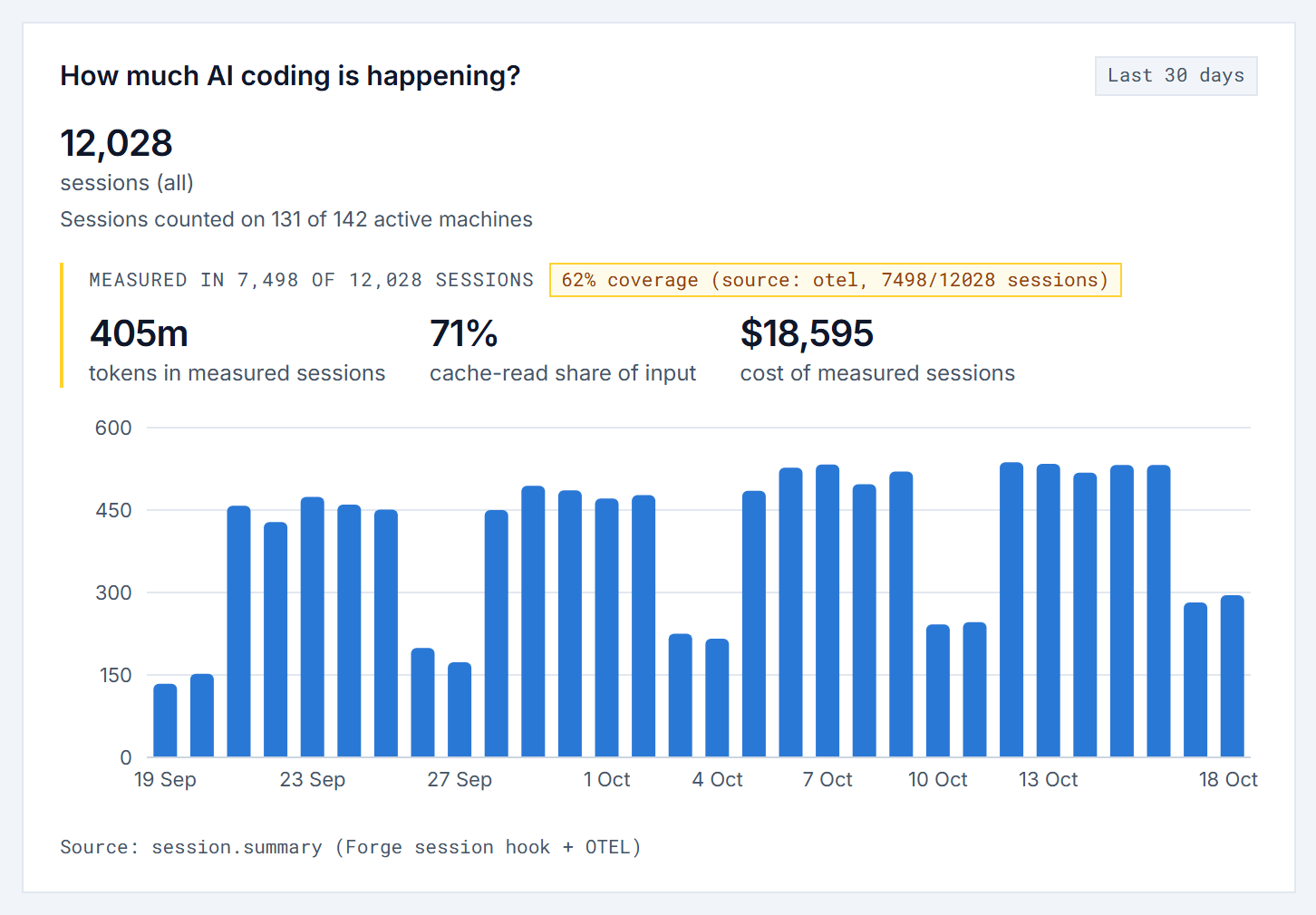
From Claude Code’s own telemetry, through a collector you host. Every figure carries its source and a coverage %, so a partial number never reads as a complete one.
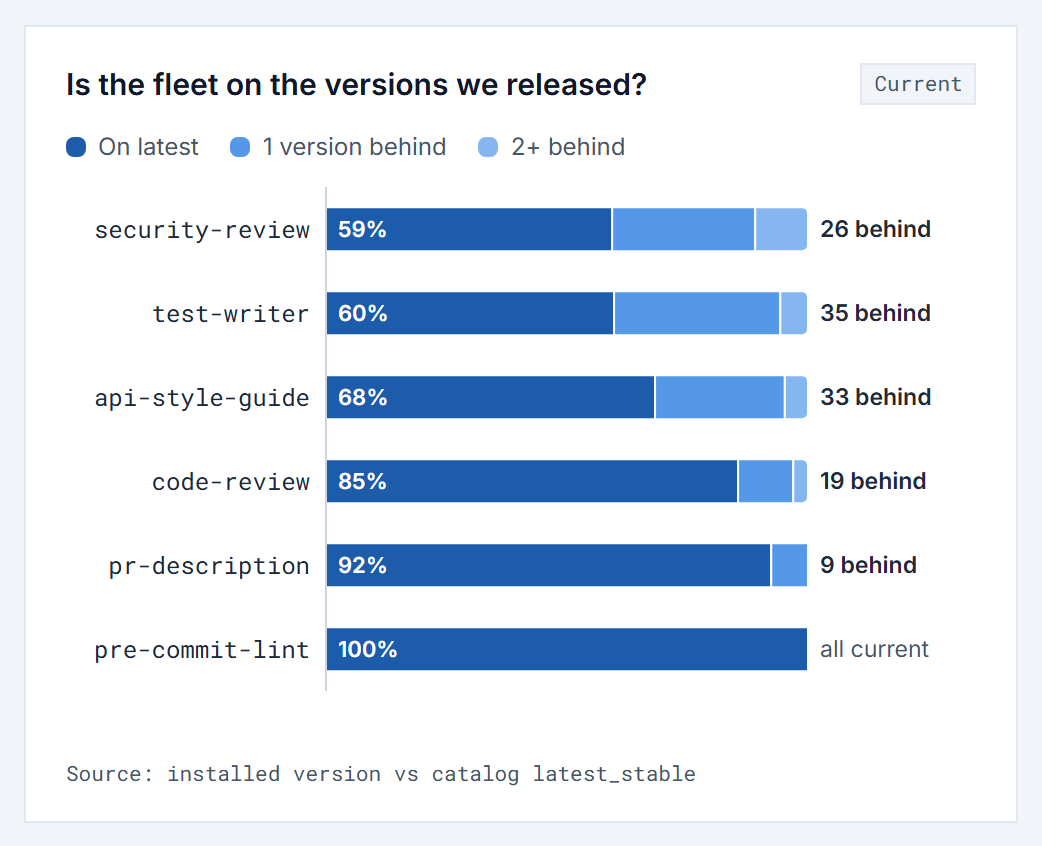
Which machines are active, which artifact versions they run and how far behind they are, from real telemetry. No prompt or code content is collected, and identities are pseudonymized. Teams are shown, never ranked individuals.
Improve
In design. Not built yet.Capabilities get better from evidence.
In design
Designed: a health view for every artifact, built from telemetry, with rules-based suggestions (no LLM). Each signal would show its source and coverage %, and each suggestion the reason it was raised, for curators and admins to act on or dismiss.
Govern
Partly available: scanning and the gate today; approvals and signing are on the roadmap.What runs was approved.
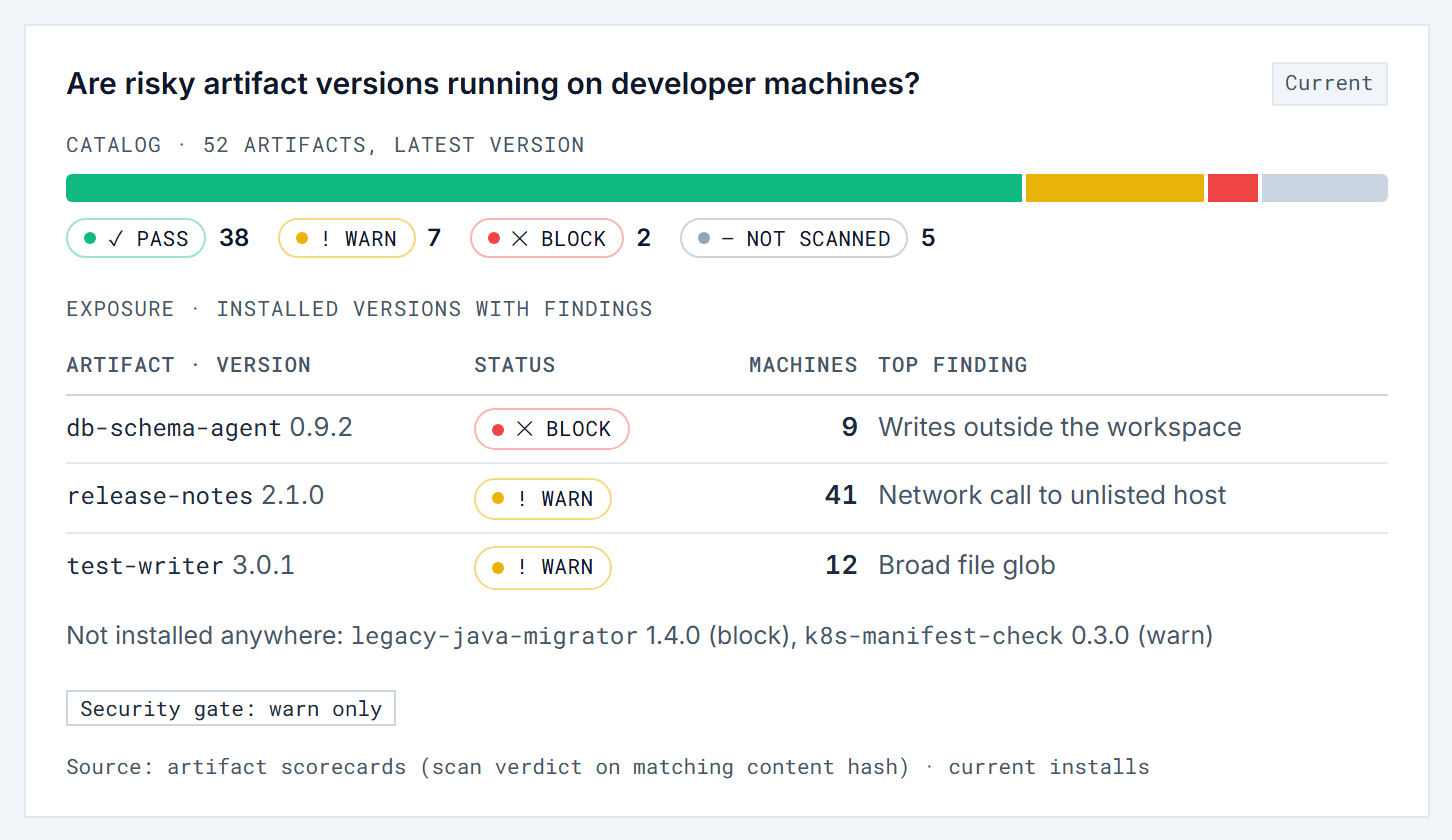
Static analysis (SkillSpector) runs in the web app whenever a registry is indexed. Scan status is shown across the catalog, and risky versions are ranked by how many machines have them installed.
An admin can switch a gate on so that skills that fail the scan are withheld.
Roadmap
Approval enforced at delivery, so an unapproved version is never served to a machine, not just hidden in the catalog.
Roadmap
Artifacts signed and verified before install, so what reaches a machine is what your organization approved.
Audit
On the roadmap. Not built yet.Every change is attributable.
Roadmap
For changes whose session can be linked, which model, skill version and agent version produced it, built from records Forge already collects, with coverage shown as a percentage. Attribution to versions and models, never ranking of people.
Roadmap
A dated history of when each artifact version was published and withdrawn.
How this fits what you already run
Enterprise Forge works at the artifact level, underneath these tools. It delivers skills, agents and hooks from your Git (to Claude Code today), keeps them current on every machine, shows what is running that no registry delivered, and measures adoption and cost with coverage shown. It complements these tools rather than replacing any of them.
Set policy for their own assistant only. They don't deliver your own skills and agents from your Git, keep them current, or show which versions are installed where.
Forge addsYour skills, agents and hooks, installed and kept current from Git.
Track models and AI applications. They don't work at the level of an individual skill, agent or hook on a developer's machine, and don't install or update one.
Forge addsThe artifact level: each skill, agent and hook, on each machine.
Show runtime behavior and model spend. They don't install or update the capabilities being run, or record which versions run on which machines.
Forge addsWhich version of each artifact runs on which machine.
Find what's running. They don't deliver the sanctioned alternative, keep it current, or measure whether anyone adopts it.
Forge addsThe sanctioned version, delivered, with adoption shown by team.
One team pilots for 90 days, free during the design partnership, with preferred pricing at conversion.
Join early access